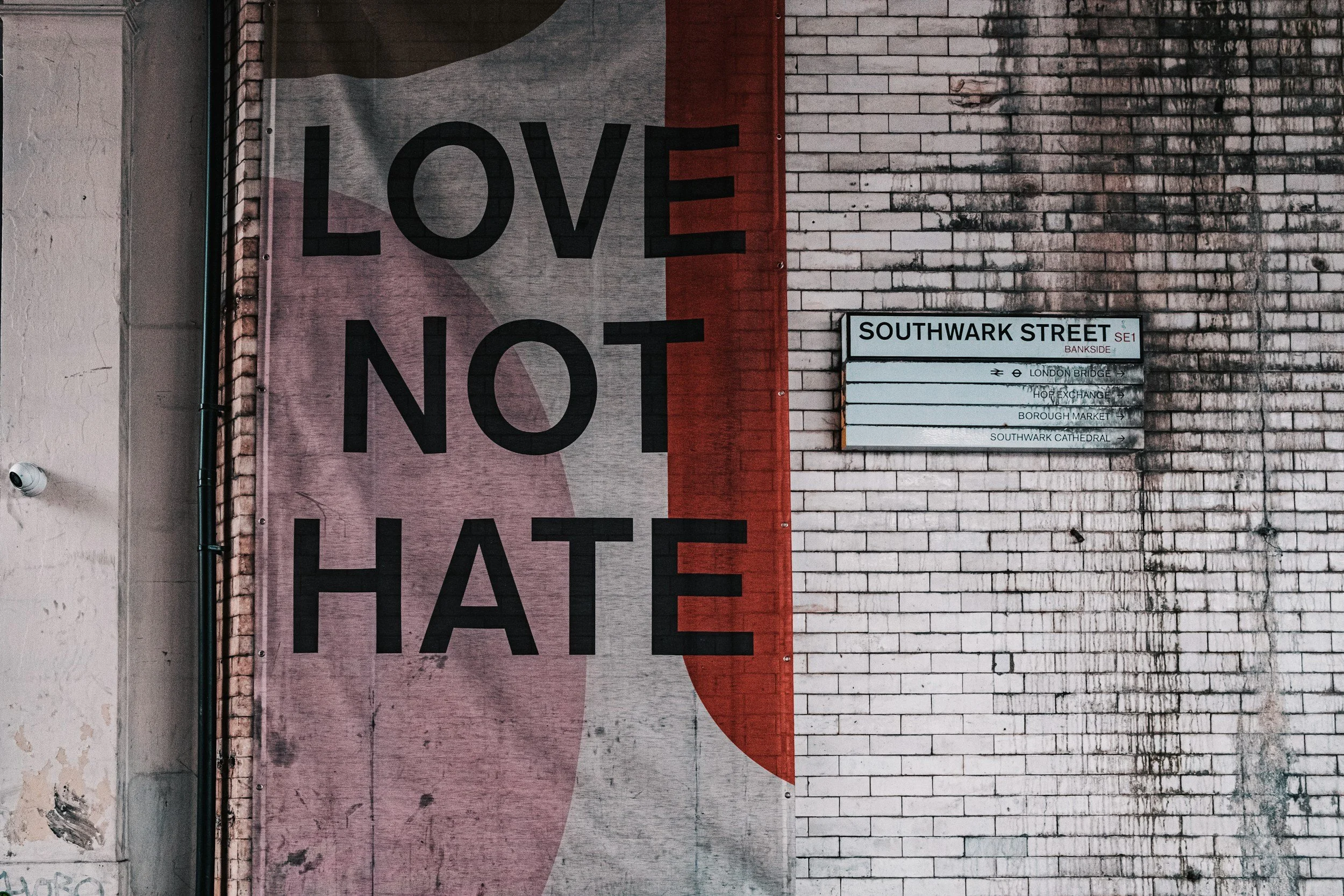
When we start scrambling: choosing love as an antidote to hate
Values-based action when the world feels loud, violent, and unstable.
March 17, 2026
Reframe: the scramble is a nervous-system signal
There are moments when the news cycle, community harm, or personal threat makes us scramble—desperately trying to do something to regain control. The scramble can look like doomscrolling, arguing, panic-planning, or freezing. It’s not a character flaw. It’s your body trying to restore safety.
And when the scramble takes over, it can pull us into the exact forces we’re trying to resist: fear, contempt, dehumanization, and disconnection.
The antidote isn’t passivity. It’s love with backbone—values-based action that keeps us human.
🧠 What helps
Connection buffers stress. Social support is one of the strongest protective factors we have when life gets threatening or uncertain (Cohen & Wills, 1985).
Contact reduces prejudice. Under the right conditions, meaningful intergroup contact reduces bias—especially when relationships are cooperative and humanizing (Pettigrew & Tropp, 2006).
Dehumanization fuels harm. When people are framed as less-than-human, cruelty becomes easier; restoring humanity is a prevention strategy (Haslam, 2006).
Stories move hearts. Narrative persuasion research shows that stories increase empathy and reduce counterarguing more reliably than lectures alone (Green & Brock, 2000).
Translation: Human connection + truthful stories + repeated action work better than rage alone.

🧭 ACT lens: choose values when fear is loud
In ACT, we don’t wait for fear to disappear before acting. We notice fear, make room for it, and choose direction anyway (Hayes, Strosahl, & Wilson, 2012).
A helpful question when you feel frantic:
“What does love look like here—without abandoning truth?”
Love can be:
checking on a neighbor
showing up to a meeting
donating to a family in crisis
correcting misinformation calmly
protecting someone being targeted
calling your representative
setting a boundary in your own home
🔧 Love in action (without lectures)
🫶 Love your people (and widen the circle)
Text one person: “I’m thinking of you. How are you really doing?”
Invite someone into a low-stakes moment (walk, coffee, kids at the park).
Repair where you can: “I don’t want distance between us—can we try again?”
🗣️ Speak truth to lies with human stories
Facts matter. But human stories cut through propaganda. When you’re trying to counter a lie, consider:
“Here’s what I’m seeing in my actual community…”
“I know someone who…”
“This is what it looks like for families/kids/workers…”
Then cite a credible source and stop. No pile-on.
(Story + source is often more effective than debate + humiliation.)
🛡️ Stand up in the moment
If you witness someone being targeted:
move closer (if safe),
check in: “Are you okay? Do you want me to stay with you?”
distract, document, or delegate help depending on safety.
Small interventions interrupt harm—and remind everyone who’s watching that people are not alone.
🧷 Untrendy but True
Hate spreads fastest when people feel isolated and afraid.
Love is slower—but it’s sturdier. It’s how we stay human while we fight for a world that is more safe, more true, and more connected.
For the Curious
📚 Books
All About Love — Bell Hooks. Love as an ethic, not a mood.
The Sum of Us — Heather McGhee. How solidarity is built (and sabotaged).
The New Jim Crow — Michelle Alexander. Systems, harm, and what truth-telling requires.
🎧 Podcasts
Your Undivided Attention — “The Cure for Hate” (Ep. 11) Former white supremacist Tony McAleer on how online ecosystems can “incubate hate,” and what actually helps people come back to compassion.
Your Undivided Attention — “The Fake News of Your Own Mind” (Ep. 19) Mindfulness teachers on stepping out of anxiety loops—perfect for your “we weren’t meant to consume this much suffering” point.
Scene on Radio — “More Truth” (Season 4, Ep. 11) How “neutral/objective” media norms can fail democracy—and why information quality matters for collective life.
🧠 References
Cohen, S., & Wills, T. A. (1985). Stress, social support, and the buffering hypothesis. Psychological Bulletin, 98(2), 310–357.
Green, M. C., & Brock, T. C. (2000). The role of transportation in the persuasiveness of public narratives. Journal of Personality and Social Psychology, 79(5), 701–721.
Haslam, N. (2006). Dehumanization: An integrative review. Personality and Social Psychology Review, 10(3), 252–264.
Hayes, S. C., Strosahl, K. D., & Wilson, K. G. (2012). Acceptance and commitment therapy: The process and practice of mindful change (2nd ed.). Guilford Press.
Pettigrew, T. F., & Tropp, L. R. (2006). A meta-analytic test of intergroup contact theory. Journal of Personality and Social Psychology, 90(5), 751–783.