Carrying What Cannot Be Fixed

reflecting on Memorial Day, grief, and the myth of closure
May 20, 2026
Memorial Day weekend tends to arrive in a flurry of cookouts, store sales, and social media tributes. For many people, it is a long weekend. For many others, it is the hardest Monday of the year.
This post is for the second group. And also for everyone who has ever been told — directly or through cultural osmosis — that grief is something you eventually get through.
You don't get through it. You learn to carry it differently. That is not a consolation prize. That is the actual truth.
🎖️ Whose grief gets witnessed on Memorial Day
Memorial Day exists to honor military personnel who died in service. That is right and important. What often gets left out is the full ecosystem of grief surrounding that loss.
Veterans who lost comrades in combat carry a grief that is rarely named publicly. Research describes it plainly: even on Memorial Day, attention focuses almost exclusively on the families of the fallen, while the grief of those who served alongside them remains largely invisible (Lubens & Silver, 2019). That invisibility is its own wound.
And then there are the children — the ones who lost a parent in uniform, who learned to say "my dad is deployed" for so long that permanence became genuinely hard to hold. The ones for whom every Memorial Day ceremony is personal in ways no one at the barbecue knows.
Grief is not distributed equally. Some losses get folded flags and national ceremonies. Others get silence and the expectation to move on.
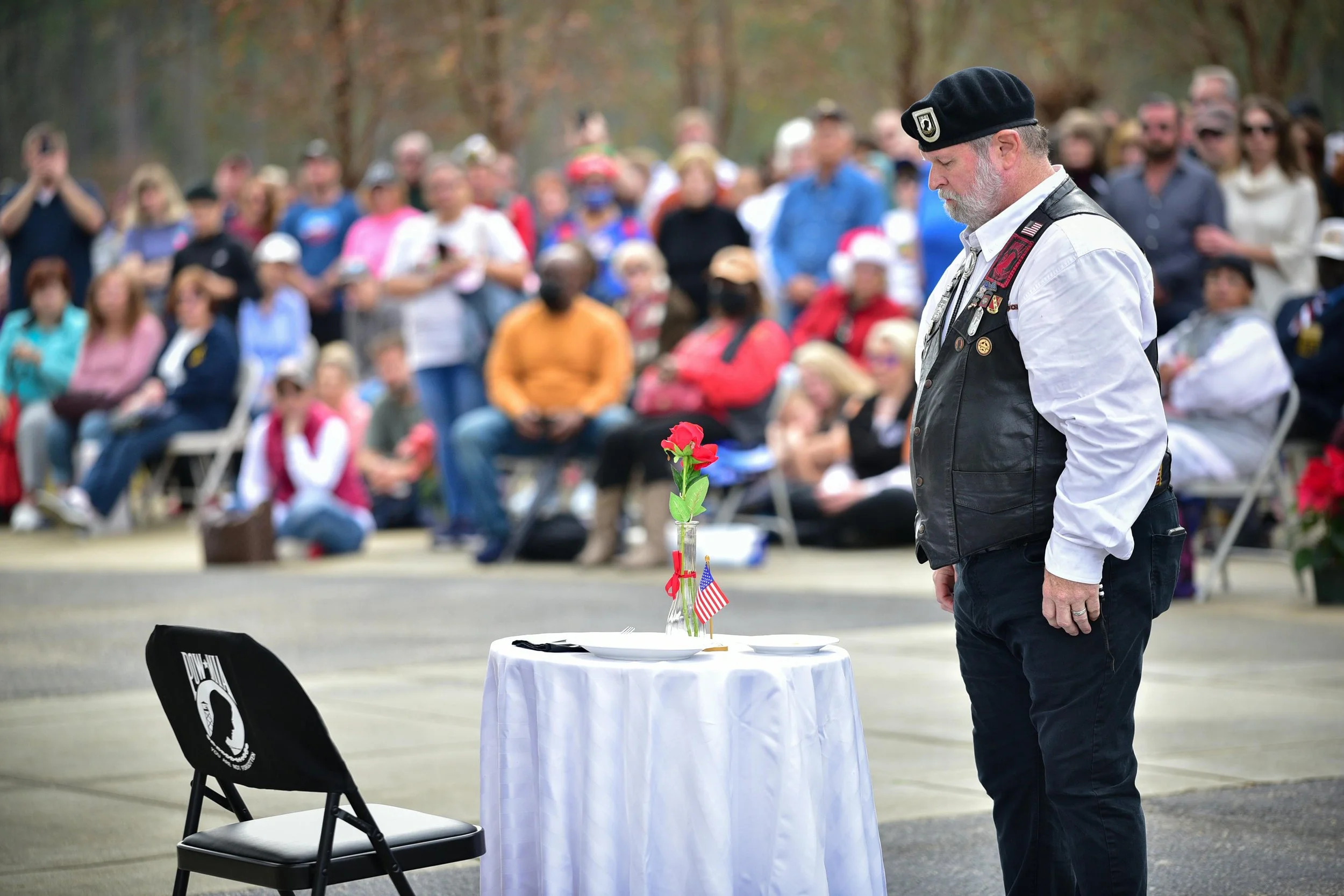
"People keep thanking me for his service. I just want someone to ask me how I'm doing."
🧠 What we actually know about grief
The five stages of grief — denial, anger, bargaining, depression, acceptance — are probably the most widely known psychological framework in popular culture. They are also widely misunderstood.
Elisabeth Kübler-Ross developed those stages to describe what she observed in people facing their own terminal diagnoses, not as a universal roadmap for bereavement. Grief does not move in a straight line. It does not have a finish line. It does not resolve on a schedule, and the absence of resolution is not pathology (Worden, 2018).
What research does consistently show is that grief is an adaptive process — one that reshapes how we think, feel, and relate to the world after a significant loss. It is biological, cognitive, emotional, and relational all at once (Cozza, as cited in American Heart Association, 2025). And it is affected by whether the loss is witnessed and validated by others, or whether it is carried in silence.
Disenfranchised grief — loss that society does not fully recognize or permit — is particularly burdensome. This includes the grief of veterans who lost comrades, families whose loved ones died by suicide, people whose relationships were not publicly acknowledged, and communities whose losses are treated as statistics rather than human beings.
“No one ever told me that grief felt so like fear.”
🌍 Collective grief and who gets to mourn
Memorial Day is also a moment to sit with a harder question: whose losses are memorialized in this country, and whose are not?
The bodies counted, the names on the wall, the ceremonies held — these are not neutral. They reflect choices about whose sacrifice is honored, whose death is grievable, and whose loss gets to be public (Butler, 2009).
This is not an argument against honoring military sacrifice. It is an invitation to widen the circle — to hold the grief of veterans of color whose service was not recognized in their lifetimes, of LGBTQ+ service members who served under policies that demanded their erasure, of families whose losses are invisible to the communities around them.
Collective grief, at its best, can build solidarity. At its worst, it can exclude. The question worth asking this Memorial Day is not only who are we remembering — but who are we forgetting.

🔧 An ACT lens: living alongside loss
One of the most clinically useful reframes I offer clients in grief is this: the goal is not to stop hurting. The goal is to keep living — fully, intentionally, with the loss as part of you rather than something to be resolved.
In Acceptance and Commitment Therapy, this is called valued living in the presence of pain. Research shows that ACT-based approaches help grieving people create psychological space around their loss — not to dismiss it, but to hold it with enough room to still engage with what matters (Willi et al., 2024).
Grief does not compete with joy. It coexists with it. You can love someone who is gone and still laugh hysterically at dinner. You can be broken open by loss and still play imagination with your children. You can carry enormous pain and still be a person who is fully alive.
Try this: Think of one person you are carrying this Memorial Day — someone whose loss lives in you. You don't have to do anything with this. Just notice what values that person represented for you. How they loved, what they stood for, what they made possible in your life. Then ask: what would it look like to honor that in something small today?
✦ Untrendy but True ✦
Closure is a myth the culture sells to make grief more comfortable for everyone except the person grieving.
You do not close. You integrate. You carry. You find — sometimes slowly, sometimes with help — a way to live that makes room for the loss without being consumed by it.
That is not weakness. That is the most human thing there is.
🌱 For the Curious
📚 Books
It's OK That You're Not OK — Megan Devine — the most honest and clinically grounded book on grief I know; she does not try to fix it, and that is exactly the point
The Year of Magical Thinking — Joan Didion — a literary masterwork on acute grief that captures what psychology often can't; essential reading for anyone who has lost someone suddenly
A Grief Observed — C.S. Lewis — raw, short, and surprisingly compatible with ACT framing on living with irreversible loss
🎧 Podcasts
Good Grief with Nora McInerny — honest, funny, and deeply human conversations about loss that do not promise resolution
On Being — Krista Tippett's interviews on meaning, suffering, and what it means to carry loss with grace; search her episodes on grief and mortality
Terrible, Thanks for Asking — Nora McInerny again, because she is that good; real people telling the truth about what grief actually looks and sounds like
📹 Videos
"There's No Right Way to Grieve" — Nora McInerny, TED Talk (2019, ~13 min) — warm, funny, and genuinely reframes what we ask of grieving people
"The Gift and Power of Emotional Courage" — Susan David, TED Talk (2017, ~16 min) — not explicitly about grief but directly relevant; her framework for emotional agility maps closely to ACT values-based living
References
Butler, J. (2009). Frames of war: When is life grievable? Verso.
Lubens, P., & Silver, R. C. (2019). Grief in veterans: An unexplored consequence of war. American Journal of Public Health, 109(S3), S198–S199. https://doi.org/10.2105/AJPH.2019.304999
Willi, N., Pancoast, A., Drikaki, I., Gu, X., Gillanders, D., & Finucane, A. (2024). Practitioner perspectives on the use of acceptance and commitment therapy for bereavement support: A qualitative study. BMC Palliative Care, 23, 59. https://doi.org/10.1186/s12904-024-01390-x
Worden, J. W. (2018). Grief counseling and grief therapy: A handbook for the mental health practitioner (5th ed.). Springer.