November 24, 2026
Gratitude, Native American Heritage Month, and the fire people carry through cruelty
🎯 Why this matters
On Thursday, many of us will gather around a table. There may be noisy bickering, or the smell of someone’s famous dish filling the room. Maybe there will be a moment of saying what we’re thankful for. Those moments are real, and they’re worth protecting.
Many of us also learned a version of Thanksgiving in school with paper headdresses and a friendly shared meal, and very little after that. It was a story told about Native people, almost never by them.
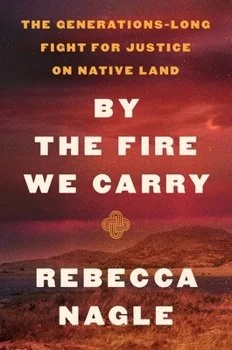
I'm reading Rebecca Nagle's By the Fire We Carry this month. Nagle is a Cherokee journalist. Before the first chapter, she places an epigraph from Muscogee poet Joy Harjo, the first Native American U.S. Poet Laureate. In "Returning from the Enemy, Part 3," the speaker panics on an ordinary sunny day. She longs to feel worthy of the sky and the earth. She has come back to homelands her people were marched away from on the authority of a piece of paper. Then the poem closes on warmth, from a fire that survived cruelty. Nagle's title comes from that image.
That poem holds the question for this week: how do we hold gratitude without erasing the people whose stories were left out?
🧠 What the science and history show
Erasure is often taught, not just forgotten. One study looked at how K–12 U.S. history standards in all 50 states represent Indigenous peoples. Roughly 87% of references placed Native peoples before 1900 (Shear et al., 2015). Many students grow up hearing about Native people only in the past tense.
Invisibility affects real people. Native youth shown only stereotyped or historical images, such as mascots, reported lower self-esteem and a lower sense of what they could become (Fryberg et al., 2008). Being missing from the story is its own harm.
Some of the most important stories are recent. In 2020, the Supreme Court ruled in McGirt v. Oklahoma that Congress had never dissolved the Muscogee (Creek) reservation. In practical terms, a treaty promise from the 1830s still holds. Most Americans have never heard of it. Nagle's book traces that case alongside her own family's history. Her ancestors were among the Cherokee leaders who signed a removal treaty against Cherokee law, a story she has said she carried for a long time before she could set it down.
Gratitude and honesty aren't opposites. Gratitude practices are linked to greater well-being (Emmons & McCullough, 2003). Nothing in that research requires pretending the past was simple. Gratitude based on accurate history tends to be sturdier.
The truth-telling has a tradition of its own. Since 1970, Native people and allies have gathered in Plymouth, Massachusetts, on Thanksgiving Day for a National Day of Mourning. It began after organizers barred Wampanoag leader Wamsutta (Frank) James from delivering a speech about his people's history at a state celebration.
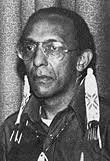
Wampanoag leader Wamsutta (Frank) James
You can read his speech here.
🧭 The ACT lens
In ACT, we notice how often the mind wants a story to be one thing. Either Thanksgiving is a beautiful family holiday, or it's a painful myth. Either I'm grateful, or I'm grieving. It can feel like we have to pick.
ACT invites a both/and stance instead. You can love the people at your table and feel the weight of the history underneath it. You can say grace and tell the truth. Holding both is uncomfortable, and that discomfort isn't a sign you're doing it wrong. Often it's a sign you're paying attention.
Harjo's image adds something essential. The people in her poem weren't only harmed. They carried something through the harm: language, ceremony, kinship, humor, stories. In ACT terms, that's what values do. They aren't feelings that vanish when life gets hard. They're the embers you keep tending, and the reason the fire is still there generations later.
Every family has untold stories too. Some were lost, some were hidden, and some, like Nagle's, are complicated to carry. Honoring Native stories this week can open a broader question: What has my family carried, and what do I want to pass on?

🗺️ Tiny experiments for this week
Name the land. Find out whose homelands you'll gather on this Thursday. Native-land.ca is a good starting point, though a tribe's own website is the best source.
Read one Native voice. Try a poem by Joy Harjo, a chapter of Nagle, or an author from your region's tribal nations. Let Native people tell it.
Offer one gratitude and one truth. At the table, or quietly to yourself, name something you're thankful for and something true that the old story left out.
Ask about an untold family story. Ask an elder: "What's a story about our family that nobody tells anymore?" Listen without rushing to fix it.
Mark Friday, too. November 27 is Native American Heritage Day. Buy from a Native-owned business or artist, or donate to a tribal language or land program.
🧷 Untrendy but true
Gratitude that leaves people out is a thinner kind of gratitude. You can keep warm by the fire and remember who carried it here.
Resources for the Curious
📚 Books
By the Fire We Carry, Rebecca Nagle. Family memoir, history, and the Supreme Court, braided into one unforgettable story of removal and return.
An American Sunrise, Joy Harjo. The collection that "Returning from the Enemy" comes from, written after Harjo returned to her family's Muscogee homelands.
Braiding Sweetgrass, Robin Wall Kimmerer. A Potawatomi botanist's vision of gratitude as reciprocity, not just a feeling. (If you used this one on Oct 13, swap in An Indigenous Peoples' History of the United States by Roxanne Dunbar-Ortiz.)
🎧 Podcasts
This Land (Crooked Media). Nagle's own podcast about the Murphy and McGirt cases, a strong companion to the book.
All My Relations. Hosts Matika Wilbur and Adrienne Keene explore contemporary Native life, identity, and culture.
Native America Calling. A long-running daily call-in program on current Native issues, in Native voices.
References
Emmons, R. A., & McCullough, M. E. (2003). Counting blessings versus burdens: An experimental investigation of gratitude and subjective well-being in daily life. Journal of Personality and Social Psychology, 84(2), 377–389. https://doi.org/10.1037/0022-3514.84.2.377
Fryberg, S. A., Markus, H. R., Oyserman, D., & Stone, J. M. (2008). Of warrior chiefs and Indian princesses: The psychological consequences of American Indian mascots. Basic and Applied Social Psychology, 30(3), 208–218. https://doi.org/10.1080/01973530802375003
Harjo, J. (2019). An American sunrise: Poems. W. W. Norton.
Hayes, S. C., Strosahl, K. D., & Wilson, K. G. (2012). Acceptance and commitment therapy: The process and practice of mindful change (2nd ed.). Guilford Press.
McGirt v. Oklahoma, 140 S. Ct. 2452 (2020).
Nagle, R. (2024). By the fire we carry: The generations-long fight for justice on Native land. Harper.
Shear, S. B., Knowles, R. T., Soden, G. J., & Castro, A. J. (2015). Manifesting destiny: Re/presentations of Indigenous peoples in K–12 U.S. history standards. Theory & Research in Social Education, 43(1), 68–101. https://doi.org/10.1080/00933104.2014.999849