The Cost of Being the Exception

R.F. Kuang's Babel and what it costs to be admitted somewhere your difference is useful but not welcome
🎯 Useful, Not Belonging
R.F. Kuang's Babel (2022) opens with a boy taken from Canton to England after his mother dies of cholera. He is raised, educated, and eventually sent to Oxford — where his fluency in Chinese is precisely what makes him valuable to an institution built on extracting meaning from languages it does not otherwise respect.
The novel is doing a lot at once: it's a fantasy about translation as magic, an argument about empire, an academic satire. But the thing I keep returning to is smaller and more interior. Robin is admitted because of his difference and diminished for it, and he spends years unable to name that contradiction, because from the inside it looks like gratitude is the only appropriate response.
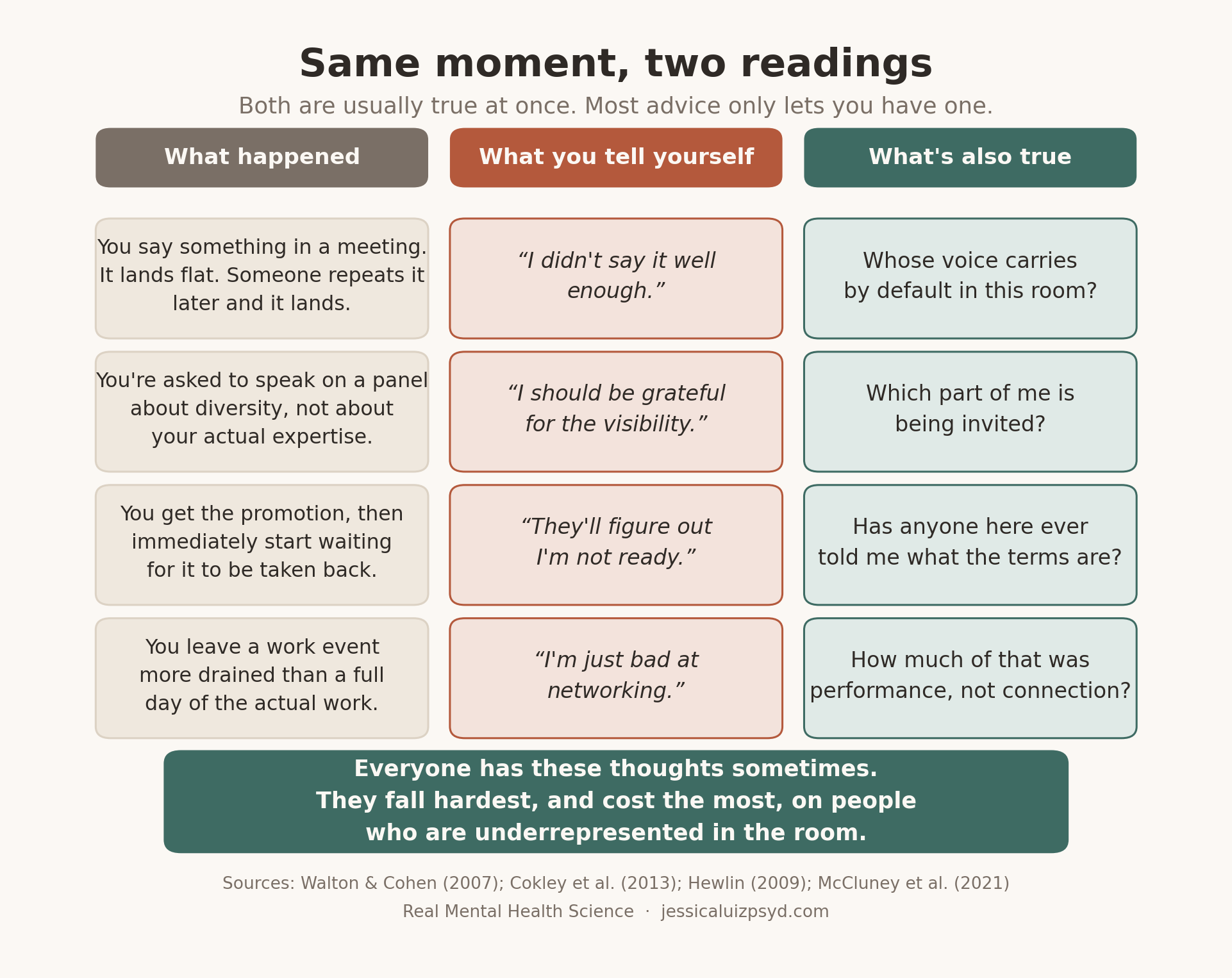
"I got everything I said I wanted. I don't know why I feel like I'm getting away with something." That's a sentence I hear often, and it's usually diagnosed as impostor syndrome — a confidence problem, located in the person, treatable with affirmations. Frequently that's a misdiagnosis. The feeling isn't always a distortion. Sometimes it's an accurate reading of an environment that made room for you conditionally, and hasn't told you what the conditions are. This week also falls inside Hispanic Heritage Month, which seems like the right time to say plainly: this experience is not culturally specific to any one group, but it is not evenly distributed either.
🧠 What the Science Shows
Belonging uncertainty is a distinct, measurable thing. Walton and Cohen (2007) described a state in which people from groups underrepresented in a setting interpret ordinary difficulties — a hard week, a cool response from a colleague — as evidence they don't belong there. Their studies found that a brief intervention framing such struggles as normal and temporary produced improvements in Black students' grades that persisted over years.
Managing your presentation has a measurable cost. Hewlin (2003, 2009) coined the term facades of conformity for suppressing personal values to appear aligned with an organization's. Employees who reported doing this showed higher emotional exhaustion and stronger intentions to leave. The performance itself is labor, and it draws from the same reserve as the actual work.
Stereotype threat consumes working memory. Steele and Aronson (1995) demonstrated that the awareness of potentially confirming a negative stereotype about one's group impairs performance in the moment. Schmader and Johns (2003) traced the mechanism: the vigilance eats working memory capacity that the task needs.
Impostor feelings track environment, not just personality. Cokley and colleagues (2013) found that among ethnic minority college students, impostor feelings predicted psychological distress more strongly than minority status stress did — and that the two operated together. The internal experience and the external environment are not separate variables.
Code-switching is real work with real returns and real costs. McCluney and colleagues (2021) found that Black employees who downplayed racial identity markers were rated as more professional — and that the same behavior was associated with burnout. It works. That's the problem.
🧭 The ACT Lens
R.F. Kuang’s main character's central problem, in ACT terms, is fusion with a story that has real evidence behind it: I am here because I am useful, and if I stop being useful in exactly this way, I will be sent back. He didn't invent it. The institution taught it to him carefully. Which is why the standard advice — be yourself, they hired you for a reason — so often lands wrong. It asks people to dispute a belief that may be partly true. ACT doesn't require you to argue with the thought. It asks a different question: what has holding this thought so tightly cost you, and is it working?
Self-as-context matters here more than usual. You are not the version of yourself that the institution rewards. You are also not the version you left behind to get in. You're the awareness that has moved between them and noticed the difference — and that noticing is the thing no environment gets to define.
There's a workability question worth asking directly: when did making myself smaller stop paying for itself? For most people there was a period when it genuinely worked — it got them in the door, it kept them safe, it may have been the only available option. Acknowledging that honestly is not weakness. What ACT invites is checking whether the strategy is still earning its cost, or whether it's running on momentum. And a hard truth the framework doesn't shy away from: sometimes the answer is that the environment is the problem, and no amount of psychological flexibility will fix an institution that only values you instrumentally. ACT's response to that is committed action, which sometimes means changing the setting rather than adapting further to it.
🔧 Skills You Can Use Today
1. Separate the accurate part from the distorted part. Take the feeling of not belonging and split it: what evidence is about this environment, and what is my mind adding? Both usually exist. Most advice collapses them into one and treats the whole thing as distortion.
2. Name the facade cost out loud once."Being in that meeting takes more out of me than the work does." Not a complaint. A measurement — and one worth having before you decide anything.
3. Test one small piece of self in a lower-stakes place. Not a dramatic unmasking. One thing you'd normally file down, offered somewhere the cost of it landing badly is survivable. Notice what actually happens versus what you predicted.
4. Ask the workability question with a date attached.When did this strategy start costing more than it returns? If you can name roughly when, you have information about what changed — you, the environment, or the stakes.
5. Find one person who doesn't require the performance. Not necessarily at work. Belonging uncertainty is powerfully reduced by evidence that somewhere, you are known without editing.
“But realize this, brother. You fly no one’s flag. You’re free to seek your own harbour. And you can do so much more than tread water.”
🧷 Untrendy but True
Being useful is not the same as being wanted, and the difference is not something you imagined. You are allowed to notice it. You are also allowed to decide what it's worth to you.
Resources for the Curious
📚 Books
Belonging — Geoffrey Cohen. From the researcher behind much of the belonging-uncertainty work; readable, and specific about what actually helps.
Minor Feelings — Cathy Park Hong. On the particular emotional register of being racially conditional in American life.
Black Skin, White Masks — Frantz Fanon. The foundational psychological account of what colonialism does inside a person, and still bracing seventy years on.
🎧 Podcasts
Code Switch — NPR's long-running show on race and identity; strong on the interior experience, not just the politics.
Hidden Brain — Several episodes on belonging, stereotype threat, and identity at work.
Time to Say Goodbye — Conversations on Asian American life, politics, and culture that resist tidy narratives.
▶️ Videos
Chimamanda Ngozi Adichie: The danger of a single story — TED — on what happens when you're only permitted one version of yourself.
R.F. Kuang on Babel — Several bookstore and festival interviews where she discusses the novel's argument about translation and empire.
References
Cokley, K., McClain, S., Enciso, A., & Martinez, M. (2013). An examination of the impact of minority status stress and impostor feelings on the mental health of diverse ethnic minority college students. Journal of Multicultural Counseling and Development, 41(2), 82–95. https://doi.org/10.1002/j.2161-1912.2013.00029.x
Hayes, S. C., Strosahl, K. D., & Wilson, K. G. (2012). Acceptance and commitment therapy: The process and practice of mindful change (2nd ed.). Guilford Press. Hewlin, P. F. (2009). Wearing the cloak: Antecedents and consequences of creating facades of conformity. Journal of Applied Psychology, 94(3), 727–741. https://doi.org/10.1037/a0015228
Kuang, R. F. (2022). Babel, or the necessity of violence: An arcane history of the Oxford translators' revolution. Harper Voyager. McCluney, C. L., Durkee, M. I., Smith, R. E., II, Robotham, K. J., & Lee, S. S.-L. (2021). To be, or not to be… Black: The effects of racial codeswitching on perceived professionalism in the workplace. Journal of Experimental Social Psychology, 97, 104199. https://doi.org/10.1016/j.jesp.2021.104199
Schmader, T., & Johns, M. (2003). Converging evidence that stereotype threat reduces working memory capacity. Journal of Personality and Social Psychology, 85(3), 440–452. https://doi.org/10.1037/0022-3514.85.3.440
Steele, C. M., & Aronson, J. (1995). Stereotype threat and the intellectual test performance of African Americans. Journal of Personality and Social Psychology, 69(5), 797–811. https://doi.org/10.1037/0022-3514.69.5.797
Walton, G. M., & Cohen, G. L. (2007). A question of belonging: Race, social fit, and achievement. Journal of Personality and Social Psychology, 92(1), 82–94. https://doi.org/10.1037/0022-3514.92.1.82