You Don’t Need To Feel It First
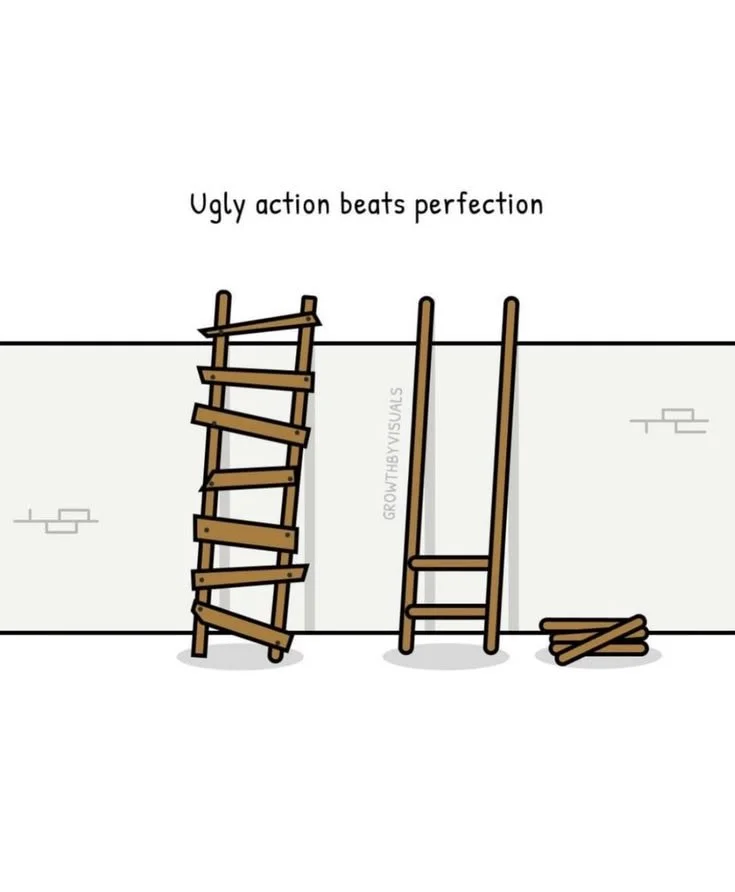
Motivation is a mood. Consistency is a choice you make over and over again
September 29, 2026
🎯 Every Cancellation Made Sense
Most of us operate on the same sequence: first you feel like doing the thing, then you do the thing. Motivation, then action. When motivation doesn't show up, you wait for it. And if it stays gone long enough, you start to conclude something is wrong with you.
The sequence is backwards, and it's worth understanding why, because a lot of self-blame lives in that gap.
Here's the shape it usually takes. You feel flat, so you cancel. Canceling brings relief — immediate, real relief, which is exactly why it works so well. But the canceled evening also removes something good from your week. With less good in the week, you feel flatter. So you cancel the next thing too.
Every one of those decisions made sense at the time. Together they form a loop that runs on its own power, and no single choice inside it looks like the problem.
The way out isn't more motivation. Motivation is a mood — it arrives unpredictably, leaves without notice, and is not something you can summon by wanting to. What you can build is consistency, which works on entirely different machinery: deciding in advance, at a size small enough to survive a bad day.
🧠 What the Science Shows
We are bad at predicting how things will feel. Wilson and Gilbert's (2005) work on affective forecasting found that people routinely mispredict both the intensity and the duration of their future emotions. Applied here: the version of you deciding at 5:45 whether to go is not a reliable narrator about what 6:15 will actually be like.
And we're wrong in a predictable direction. Ruby and colleagues (2011) found people consistently expected to enjoy exercising less than they actually did — the gap large enough that the researchers described the payoff as invisible. The forecast doesn't just miss. It skews pessimistic.
Deciding in advance beats deciding in the moment. Gollwitzer and Sheeran's (2006) meta-analysis of 94 studies found that forming a specific when-where-how plan had a medium-to-large effect on follow-through, compared with holding the same goal without one. What separates the two isn't willpower. It's specificity.
Consistency doesn't require perfection. Lally and colleagues (2010) tracked people building a new daily behavior and found automaticity took a median of 66 days, with enormous variation between individuals. Missing a single day did not meaningfully set the process back. The all-or-nothing story most of us carry about habits isn't supported by the data.
Small immediate payoffs sustain behavior better than large distant ones. Woolley and Fishbach (2017) found that how much people enjoyed something in the moment predicted persistence more strongly than how much they valued the long-term outcome. Choosing things with some near-term reward isn't self-indulgent. It's what makes them survivable.
Scheduling activity reliably lifts mood. Across 26 randomized trials, structured activity scheduling produced significant improvements in depressive symptoms compared with control conditions (Ekers et al., 2014). And it isn't only useful when things are bad — a separate meta-analysis found the same approach improved wellbeing in people who weren't depressed at all (Mazzucchelli et al., 2010).
🧭 The ACT Lens
Acceptance and Commitment Therapy has a phrase for this: committed action. Not action that feels good. Not action you're motivated toward. Action that moves you toward what you actually care about, undertaken alongside whatever you happen to be feeling at the time.
The thing standing in the way is usually a rule the mind treats as physics: I'll do it when I feel up to it. That sounds like an observation about how human beings work. It's a thought — and held tightly enough, it will keep you on the couch indefinitely.
Defusion just means noticing it as language. "I'm having the thought that I need to feel better first." You can have that thought and stand up anyway. Both things fit in the same body.
There's also a workability question worth putting plainly. Canceling works. Withdrawing works. Both deliver relief on contact, which is precisely why they're so hard to give up. The honest question isn't whether they work in the moment — it's whether the strategy has been building you a life you want over the last several months.
One boundary matters here. This is not grinding, pushing through, or overriding what your body is telling you. Committed action is values-guided, at a size you can actually complete. It's the opposite of forcing yourself through things that don't matter to you. If you can't name why something matters, the answer isn't to try harder — it's to pick something else.

Skills You Can Use Today
1. Track for three days before changing anything. Write down what you did each hour and rate your mood 0–10. Nothing else. Most people find their assumptions about what lifts and lowers their mood are partly wrong, and an accurate map is worth more than early effort.
2. Schedule the specific action, not the intention. Not "walk more." Instead: Wednesday, 6pm, to the end of the block and back. When, where, how. Specificity is doing the work here, not resolve.
3. Make the first one embarrassingly small. Whatever size feels reasonable, cut it in half. The goal for week one is completion, not benefit. Failing an ambitious plan reinforces the exact story you're trying to get out from under.
4. Go on schedule, not on feeling — and check in afterward. This is the whole method. When it's time, you go, whether or not the wanting arrived. Then rate your mood after. The gap between prediction and reality is usually the thing that convinces people.
5. Choose something with a payoff you'll actually notice. Not just what's good for you in the abstract. Something with a bit of pleasure, connection, or satisfaction close enough to feel. That's what keeps it going past week two.
6. Plan for the missed day now, while it's hypothetical. Decide in advance that one skipped session means you do the next one, not that the whole thing is over. Missing is part of the process, not evidence against you.
🧷 Untrendy but True
You will not feel like it. That was never the requirement. Go anyway, whatever you can manage, and let your mood catch up on its own schedule.
Resources for the Curious
📚 Books
Overcoming Depression One Step at a Time — Michael Addis & Christopher Martell. The behavioral activation self-help workbook, written by two of the researchers behind the trials.
The Upward Spiral — Alex Korb. A neuroscientist's accessible account of why small actions shift mood, with practical application throughout.
Feeling Good — David Burns. Not behavioral activation specifically, but the most widely used free-standing self-help book for depression, and it includes activity scheduling.
🎧 Podcasts
The Happiness Lab — Laurie Santos on the gap between what we predict will help and what actually does.
Feeling Good — David Burns' show; practical and demonstration-heavy rather than abstract.
Ten Percent Happier — Frequently covers behavioral approaches alongside meditation, without treating either as a cure-all.
▶️ Videos
Alex Korb on the upward spiral — Recorded talks on the neuroscience of small behavioral changes.
Kevin Breel: Confessions of a depressed comic — TED — not about the method, but a clear account of what withdrawal actually feels like from inside.
References
Dimidjian, S., Hollon, S. D., Dobson, K. S., Schmaling, K. B., Kohlenberg, R. J., Addis, M. E., Gallop, R., McGlinchey, J. B., Markley, D. K., Gollan, J. K., Atkins, D. C., Dunner, D. L., & Jacobson, N. S. (2006). Randomized trial of behavioral activation, cognitive therapy, and antidepressant medication in the acute treatment of adults with major depression. Journal of Consulting and Clinical Psychology, 74(4), 658–670. https://doi.org/10.1037/0022-006X.74.4.658
Ekers, D., Webster, L., Van Straten, A., Cuijpers, P., Richards, D., & Gilbody, S. (2014). Behavioural activation for depression: An update of meta-analysis of effectiveness and sub group analysis. PLoS ONE, 9(6), e100100. https://doi.org/10.1371/journal.pone.0100100
Gortner, E. T., Gollan, J. K., Dobson, K. S., & Jacobson, N. S. (1998). Cognitive-behavioral treatment for depression: Relapse prevention. Journal of Consulting and Clinical Psychology, 66(2), 377–384. https://doi.org/10.1037/0022-006X.66.2.377
Hayes, S. C., Strosahl, K. D., & Wilson, K. G. (2012). Acceptance and commitment therapy: The process and practice of mindful change (2nd ed.). Guilford Press.
Jacobson, N. S., Dobson, K. S., Truax, P. A., Addis, M. E., Koerner, K., Gollan, J. K., Gortner, E., & Prince, S. E. (1996). A component analysis of cognitive-behavioral treatment for depression. Journal of Consulting and Clinical Psychology, 64(2), 295–304. https://doi.org/10.1037/0022-006X.64.2.295
Mazzucchelli, T. G., Kane, R. T., & Rees, C. S. (2010). Behavioral activation interventions for well-being: A meta-analysis. Journal of Positive Psychology, 5(2), 105–121. https://doi.org/10.1080/17439760903569154
Richards, D. A., Ekers, D., McMillan, D., Taylor, R. S., Byford, S., Warren, F. C., Barrett, B., Farrand, P. A., Gilbody, S., Kuyken, W., O'Mahen, H., Watkins, E. R., Wright, K. A., Hollon, S. D., Reed, N., Rhodes, S., Fletcher, E., & Finning, K. (2016). Cost and outcome of behavioural activation versus cognitive behavioural therapy for depression (COBRA): A randomised, controlled, non-inferiority trial. The Lancet, 388(10047), 871–880. https://doi.org/10.1016/S0140-6736(16)31140-0