Record Profits, Fewer Workers
The exhaustion you're carrying is not a personal failure of resilience — and the historical record is unusually clear about why

September 1, 2026
🎯 Who the Economy Is Actually For
Last Labor Day I wrote about self-care as something you build rather than buy. This year I want to say the harder thing out loud: the reason so many people are exhausted is not that they've failed to optimize their routines. It's that they are working inside a system currently organized around returns to capital, and their labor is an input in that system rather than a purpose of it.
“Pray for the dead and fight like hell for the living.”
Mother Jones said that line to a room of miners who were being charged rent to hold their own union meeting in a church. Her point was not that grief is wrong. It was that ritual comfort, on its own, changes nothing about the conditions that produced the loss.
I think about that distinction often, because a version of it shows up in my office weekly. People arrive with good performance reviews and a specific kind of dread anyway — refreshing the company news, reading the tone of a rescheduled meeting, running the math on how many months they could cover rent.
The questions they bring aren't abstract. Can we sign a lease that long? Should we start trying for a second kid? Is it reckless to move closer to my mother when the job that pays for all of it could end in a Tuesday morning email? Some distortion may exist, but I’ve found a lot of it is accurate threat detection in a labor market where doing your job well has stopped reliably purchasing security — and where the future you were told to plan for requires a stability nobody is actually offering you.
🧠 What the Record Shows
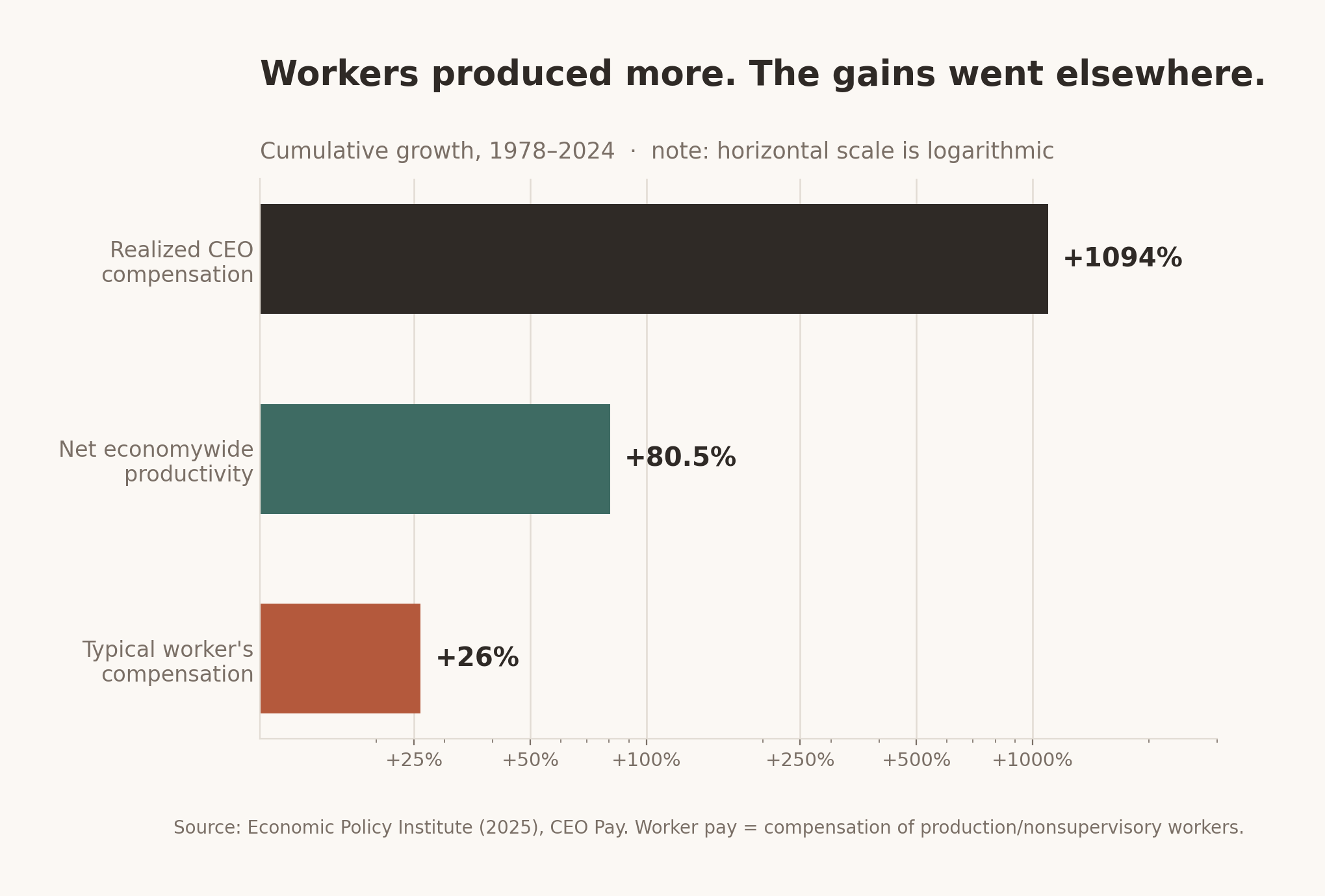
Productivity and pay stopped moving together.
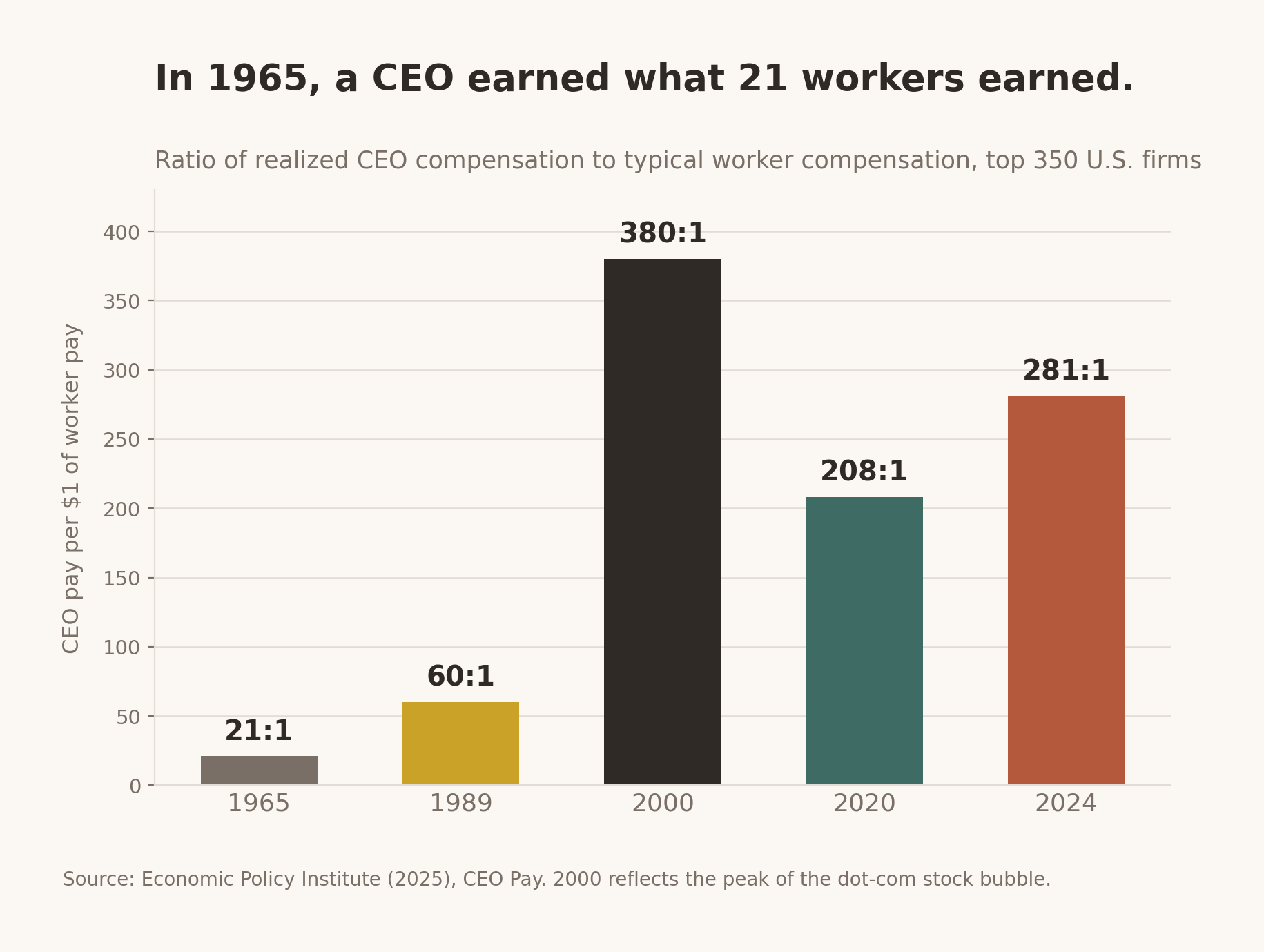
Between 1978 and 2024, net economy wide productivity grew 80.5% while compensation for a typical worker grew 26%. Over the same period, realized CEO compensation grew 1,094%. The CEO-to-worker compensation ratio was 281-to-1 in 2024; in 1965 it was 21-to-1 (Economic Policy Institute, 2025). Workers produced substantially more. The gains went somewhere else.
Profitability and job security have come apart.
In 2026, several companies announced significant layoffs while simultaneously reporting record results — Cloudflare cut roughly 20% of its workforce in May in the same quarter it reported its highest revenue in company history, and Cisco cut nearly 4,000 roles after beating profit and revenue expectations, with its CFO stating explicitly that the restructuring was not savings-driven (TechCrunch, 2026). Meanwhile, the four largest cloud companies committed roughly $700 billion in capital expenditure for the year. Capital is not scarce right now. Jobs are being cut anyway.
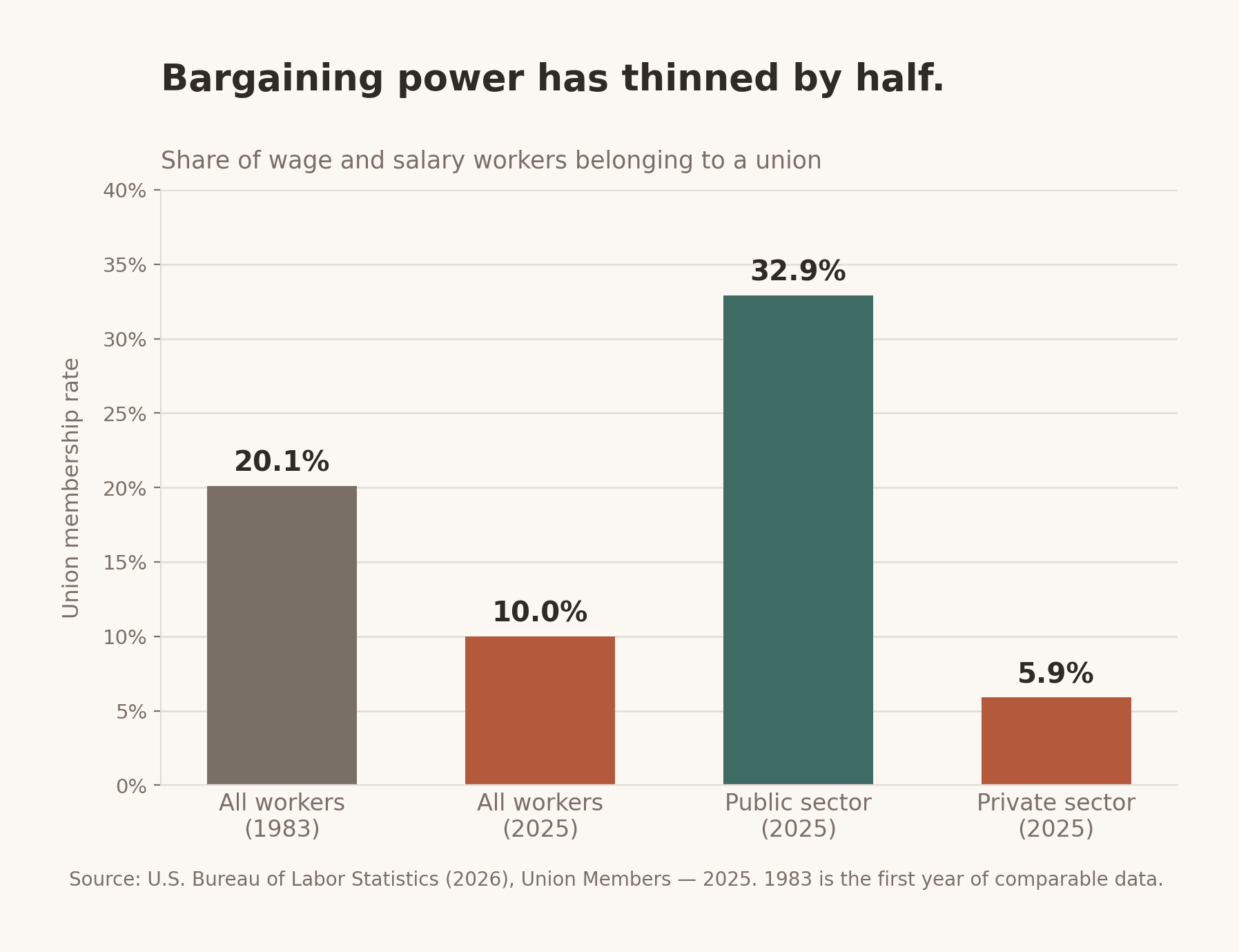
Collective bargaining power has thinned.
Union membership was 10.0% of wage and salary workers in 2025 — 5.9% in the private sector — down from 20.1% in 1983, the first year of comparable data (U.S. Bureau of Labor Statistics, 2026). Union members' median weekly earnings were $1,404 versus $1,174 for nonunion workers.
Class is a health variable, not just an economic one. Chetty and colleagues (2016) found a 14.6-year gap in life expectancy between men in the top and bottom 1% of the income distribution, and 10.1 years for women. Wilkinson and Pickett have documented that more unequal societies show worse outcomes on mental illness, addiction, and social trust — not just among the poorest, but across the distribution.
Financial strain does measurable things to cognition and mood. Mani et al. (2013) found that the mental preoccupation of financial scarcity itself consumes cognitive bandwidth. Ridley and colleagues (2020) reviewed the causal evidence and concluded the relationship between poverty and depression and anxiety runs in both directions — poverty causes psychological suffering, and psychological suffering deepens poverty.
🧭 A Little History, Because It Repeats
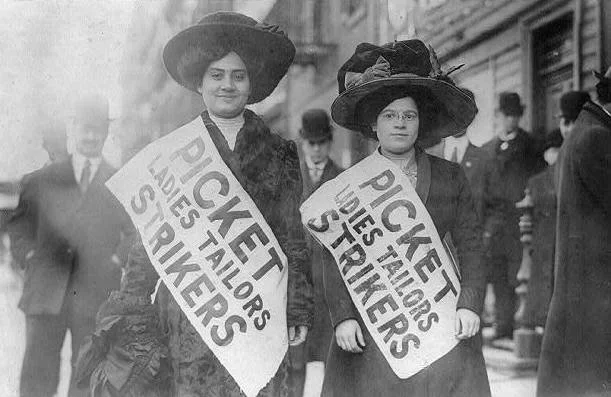
None of the protections we associate with this holiday were granted. Each one has a body count attached.
On March 25, 1911, 146 garment workers — mostly young immigrant women — died in the Triangle Shirtwaist Factory fire in New York, some at exit doors that had been locked. The public outrage produced the Factory Investigating Commission and the fire and safety codes that followed. In April 1914, the Colorado National Guard and company guards attacked a tent colony of striking coal miners and their families at Ludlow; roughly two dozen people were killed, including women and children. In 1892, Carnegie Steel brought armed Pinkerton agents against strikers at Homestead.
And when the New Deal finally wrote labor protections into federal law, agricultural and domestic workers were deliberately excluded from both the National Labor Relations Act (1935) and the Fair Labor Standards Act (1938) — occupations then held disproportionately by Black Americans, carved out to secure Southern votes (Perea, 2011). Farmworkers remain excluded from federal overtime protection to this day.
In 1981, when air traffic controllers struck, more than 11,000 were fired and permanently replaced. Labor historians generally mark that as a signal to employers that permanent replacement was politically survivable.
Here is the pattern: protections arrive after harm, unevenly, to the people with the most bargaining power, and they erode when that power thins. What's happening in 2026 is not new. The technology is new. The logic is not.
🧭 The ACT Lens
I want to be careful here, because ACT can be misused as a tool for adjusting people to conditions that ought to be changed. Acceptance is not endorsement, and it is definitely not resignation.
What acceptance offers is this: you can stop spending energy arguing with reality. You can hold clearly that the system is not organized for your flourishing, that no employer will love you back, that your job security is not a referendum on your worth — and let that be true without collapsing.
The energy that frees up is the energy that goes toward committed action. And ACT is explicit that committed action includes acting with others toward what you value. The single most reliable historical mechanism for improving working conditions has never been individual resilience. It has been collective.
Where classism does its quietest damage is internally. Liu and colleagues (2004) describe how people absorb class messaging as a lens on their own worth — so a layoff becomes evidence of personal inadequacy rather than a line item in a capital reallocation. That misattribution is worth interrupting on its own terms.
🔧 Skills You Can Use Today
1. Attribute accurately. When the self-blame narrative arrives, ask: what portion of this is mine, and what portion is structural? Accuracy isn't excuse-making. Misattributing a systemic outcome to your own defectiveness is a factual error with real psychological cost.
2. Defuse from the productivity story. Practice the phrasing: "I'm having the thought that I'm only worth what I produce." Say it out loud once. Notice it's a thought a system taught you, not a fact about you.
3. Talk to your coworkers about pay. Discussing wages and working conditions with colleagues is protected concerted activity under Section 7 of the NLRA for most private-sector employees. Silence about compensation serves exactly one party.
4. Move one thing from individual to collective. Join the union if you have one. Learn what your state's labor protections actually are. Support the workers in your area who never got covered in the first place. Individual coping has a ceiling; this is what's on the other side of it.
🧷 Untrendy but True
You cannot out-resilience a structural problem, and you were never supposed to have to. Rest anyway — and then remember that everything you're resting on, someone fought for.
Resources for the Curious
📚 Books
Work Won't Love You Back — Sarah Jaffe. On the "do what you love" narrative and how it keeps people working for less.
The Inner Level — Richard Wilkinson & Kate Pickett. Their follow-up to The Spirit Level, specifically on what inequality does to mental health and self-esteem.
Deaths of Despair and the Future of Capitalism — Anne Case & Angus Deaton. The mortality data on what happened to Americans without a college degree.
🎧 Podcasts
Belabored — Dissent Magazine's long-running labor show; strong on the workers standard coverage skips.
Pitchfork Economics — Nick Hanauer's show on inequality, argued from inside the investor class.
Reveal — Investigative reporting that returns repeatedly to wage theft and worker safety.
▶️ Videos
Richard Wilkinson: How economic inequality harms societies — TED — the clearest short presentation of the health data.
Wealth Inequality in America — Politizane — nine minutes of animated data on the gap between what people assume and what's actually true.
References
Case, A., & Deaton, A. (2020). Deaths of despair and the future of capitalism. Princeton University Press.
Chetty, R., Stepner, M., Abraham, S., Lin, S., Scuderi, B., Turner, N., Bergeron, A., & Cutler, D. (2016). The association between income and life expectancy in the United States, 2001–2014. JAMA, 315(16), 1750–1766. https://doi.org/10.1001/jama.2016.4226
Economic Policy Institute. (2025). CEO pay. https://www.epi.org/publication/ceo-pay/
Hayes, S. C., Strosahl, K. D., & Wilson, K. G. (2012). Acceptance and commitment therapy: The process and practice of mindful change (2nd ed.). Guilford Press.
Jones, M. H. (1925). The autobiography of Mother Jones (M. F. Parton, Ed.). Charles H. Kerr.
Liu, W. M., Soleck, G., Hopps, J., Dunston, K., & Pickett, T., Jr. (2004). A new framework to understand social class in counseling: The social class worldview model and modern classism theory. Journal of Multicultural Counseling and Development, 32(2), 95–122. https://doi.org/10.1002/j.2161-1912.2004.tb00364.x
Mani, A., Mullainathan, S., Shafir, E., & Zhao, J. (2013). Poverty impedes cognitive function. Science, 341(6149), 976–980. https://doi.org/10.1126/science.1238041
Perea, J. F. (2011). The echoes of slavery: Recognizing the racist origins of the agricultural and domestic worker exclusion from the National Labor Relations Act. Ohio State Law Journal, 72(1), 95–138.
Ridley, M., Rao, G., Schilbach, F., & Patel, V. (2020). Poverty, depression, and anxiety: Causal evidence and mechanisms. Science, 370(6522), eaay0214. https://doi.org/10.1126/science.aay0214
U.S. Bureau of Labor Statistics. (2026). Union members — 2025. U.S. Department of Labor. https://www.bls.gov/news.release/union2.nr0.htm
Wilkinson, R., & Pickett, K. (2018). The inner level: How more equal societies reduce stress, restore sanity and improve everyone's well-being. Penguin Press.